Cargo & Freight · Driver Training VideoStep Deck, Lowboy & RGN Operations
Deck height sets how much load height is legal, and a wrong guess means running overheight before the first mile. Drivers learn step deck, lowboy and RGN differences, gooseneck loading, ramp angles, and measuring real height.
 Branded with your logo & company name
What drivers learn
Start with the basics
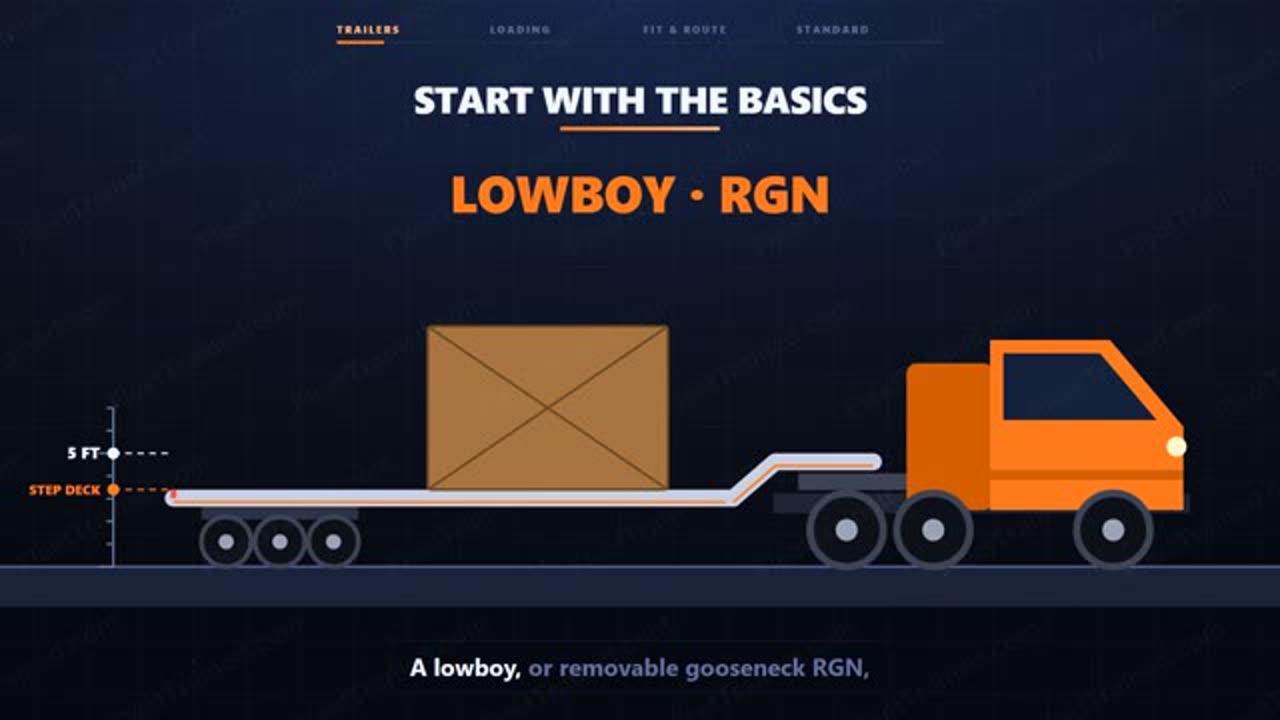
A standard flatbed deck sits around five feet off the ground. A step deck, also called a drop deck, drops the main deck lower so you can carry taller loads. A lowboy, or removable gooseneck — RGN — sits lowest of all.
Here's why deck height matters: it sets your legal cargo height. Most states target a total height of thirteen feet six inches. Whatever your deck height is, that's how much load height you actually have left to work with.
Loading a removable gooseneck has its own procedure. Detach the gooseneck, drive the equipment on from the front, and before any of that — check that the ground under the gooseneck can bear the weight. Soft ground is not your friend here.
Ramps on a step deck or a beavertail have a break-over angle. Long, low equipment can high-center on a steep ramp — the frame catches before the wheels are even loaded. Use the right ramps for the equipment, and take the right approach angle. Don't guess your way up a ramp.
Soft ground and grade are the enemy on every load like this. The trailer can shift, or the gooseneck can sink right into the dirt. Load on firm, level ground, and use a spotter — every time, no exceptions.
Match the trailer to the load. Don't put a tall load on a flatbed when a step deck would keep you legal. And never — never — exceed the deck rating or the axle ratings just to make a load fit.
A lower deck is not permission to stop measuring. Measure your loaded height for real, every time, and route for the bridges on your route. The bridge always wins that argument.
The securement physics don't change between trailer types, but the anchor points do. Use the rated tie-down points built into that specific trailer, not whatever looks convenient.
Sample quiz questions
3 of the 10 questions drivers answer after the video. Quizzes run in the driver's own language.
- Standard flatbed
- Step deck
- They all sit at the same height
- Removable gooseneck (RGN)
Show answer
Removable gooseneck (RGN)
- 12 feet 0 inches
- 14 feet 6 inches
- 13 feet 6 inches
- 15 feet 0 inches
Show answer
13 feet 6 inches
- Tire pressure on the trailer
- Fuel level of the equipment
- That the ground under the gooseneck can bear the weight
- The weather forecast
Show answer
That the ground under the gooseneck can bear the weight
How fleets use this training
Pick Step Deck, Lowboy & RGN Operations and send each driver a personal link by email, or copy the link and text it yourself.
Drivers watch on their phone and answer the quiz in their own language. No app, no login.
They sign on screen and get a certificate with your logo. Every completion is saved for DOT and insurance.
Train your drivers on Step Deck, Lowboy & RGN Operations
Included in the Full Library plan ($129.99/mo, unlimited drivers). Unlimited drivers, cancel anytime. Prefer to own it? Order it branded for $4.99, one time.
Frequently asked questions
How long is the Step Deck, Lowboy & RGN Operations training video?
About 3 min. Drivers watch it on their phone from a personal link, then take a 10-question quiz.
Is there a quiz and a completion certificate?
Yes. Every driver takes a 10-question quiz in their own language, signs on screen, and gets a completion certificate with your company name and logo. Records are saved for DOT audits and insurance.
Which languages is it available in?
Ready today in English. You can also order it branded in any other language for $2.99 per extra language.
How much does it cost?
Included in the Full Library plan ($129.99/mo, unlimited drivers). You can also order this video branded with your logo and company name in the voiceover for a one-time $4.99, yours to keep.