Cargo & Freight · Driver Training VideoLoad Locks & Van Freight
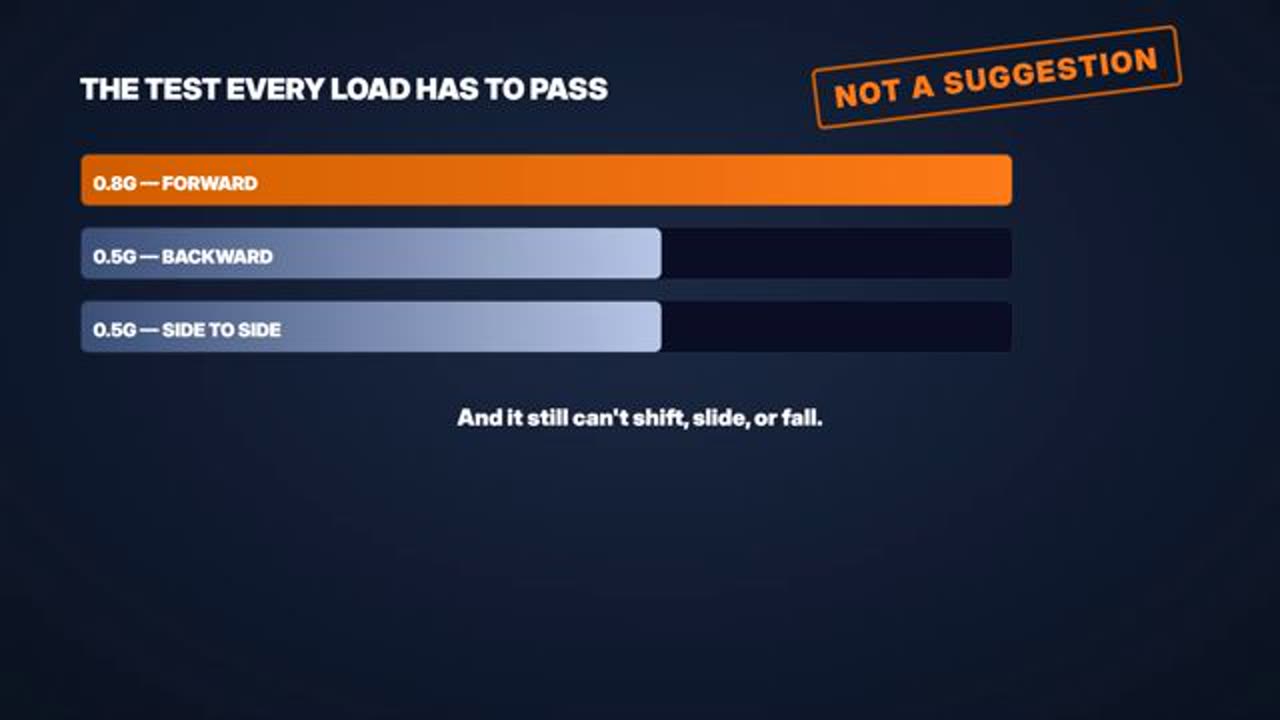
Federal securement rules assume freight survives 0.8 g forward and half a g backward and sideways without shifting. Drivers learn to rate, place, and cover van freight with load locks so a hard stop does not move the load.
 Branded with your logo & company name
What drivers learn
Every load you haul has to survive one thing: hard braking. Federal cargo securement rules assume your freight gets hit with 0.8 g decelerating forward, half a g backward, and half a g side to side — and it still can't shift, slide, or fall. That's not a suggestion.
In a dry van, your main tool for that test is the load lock — also called a load bar or decking bar. It wedges between the trailer's E-track or logistic track and holds a section of freight from sliding forward or backward. Here's what trips drivers up.
First: rating
Every load lock has a working load limit stamped on it. If you don't know it, you don't know what you're protecting. Never stack more weight against one bar than it's rated for — split the load across more bars instead.
Second: placement
A load lock only works if both ends are seated in a rated track slot or braced against a solid structural point — not resting against the rear doors, not wedged against a stack of boxes that can crush. The doors are not a load-bearing wall. Treat them like they're not there.
Third: coverage
One bar across the top of a stack does nothing for freight that can shift underneath it. Tall or mixed freight often needs bars at more than one height, plus dunnage — airbags, honeycomb, or void-fill — to close gaps so nothing has room to build momentum before it hits anything.
Fourth: the math behind it
The rules require the combined strength of your securement — bars, straps, and blocking together — to hold at least half the weight of what you're restraining. One light-duty bar wedged against a heavy pallet isn't securement. It's decoration.
Your company standard: block and brace every shipment so it can't move in any direction before you shut the doors — not after a rattle at the first turn.
A shifted load isn't just a mess to clean up. It's a violation, a possible out-of-service order, and on a bad day, it's freight coming through the wall behind your seat. Take the extra five minutes.
Sample quiz questions
3 of the 10 questions drivers answer after the video. Quizzes run in the driver's own language.
- 0.5 g
- 1.0 g
- 0.3 g
- 0.8 g
Show answer
0.8 g
- Load bar
- Tie-down strap
- Ratchet chain
- Corner protector
Show answer
Load bar
- Against the rear doors
- Under the pallet
- The E-track or logistic track
- Around the axle
Show answer
The E-track or logistic track
How fleets use this training
Pick Load Locks & Van Freight and send each driver a personal link by email, or copy the link and text it yourself.
Drivers watch on their phone and answer the quiz in their own language. No app, no login.
They sign on screen and get a certificate with your logo. Every completion is saved for DOT and insurance.
Train your drivers on Load Locks & Van Freight
Included in the Full Library plan ($129.99/mo, unlimited drivers). Unlimited drivers, cancel anytime. Prefer to own it? Order it branded for $4.99, one time.
Frequently asked questions
How long is the Load Locks & Van Freight training video?
About 3 min. Drivers watch it on their phone from a personal link, then take a 10-question quiz.
Is there a quiz and a completion certificate?
Yes. Every driver takes a 10-question quiz in their own language, signs on screen, and gets a completion certificate with your company name and logo. Records are saved for DOT audits and insurance.
Which languages is it available in?
Ready today in English. You can also order it branded in any other language for $2.99 per extra language.
How much does it cost?
Included in the Full Library plan ($129.99/mo, unlimited drivers). You can also order this video branded with your logo and company name in the voiceover for a one-time $4.99, yours to keep.