Cargo & Freight · Driver Training VideoPipe, Tube & Cylindrical Loads
Round loads roll, so the job is to stop the roll side to side and the shift front to back. Drivers learn chocking the bottom row, stable nesting, dunnage between layers, and edge protection on sharp pipe ends.
 Branded with your logo & company name
What drivers learn
Start with the bottom row
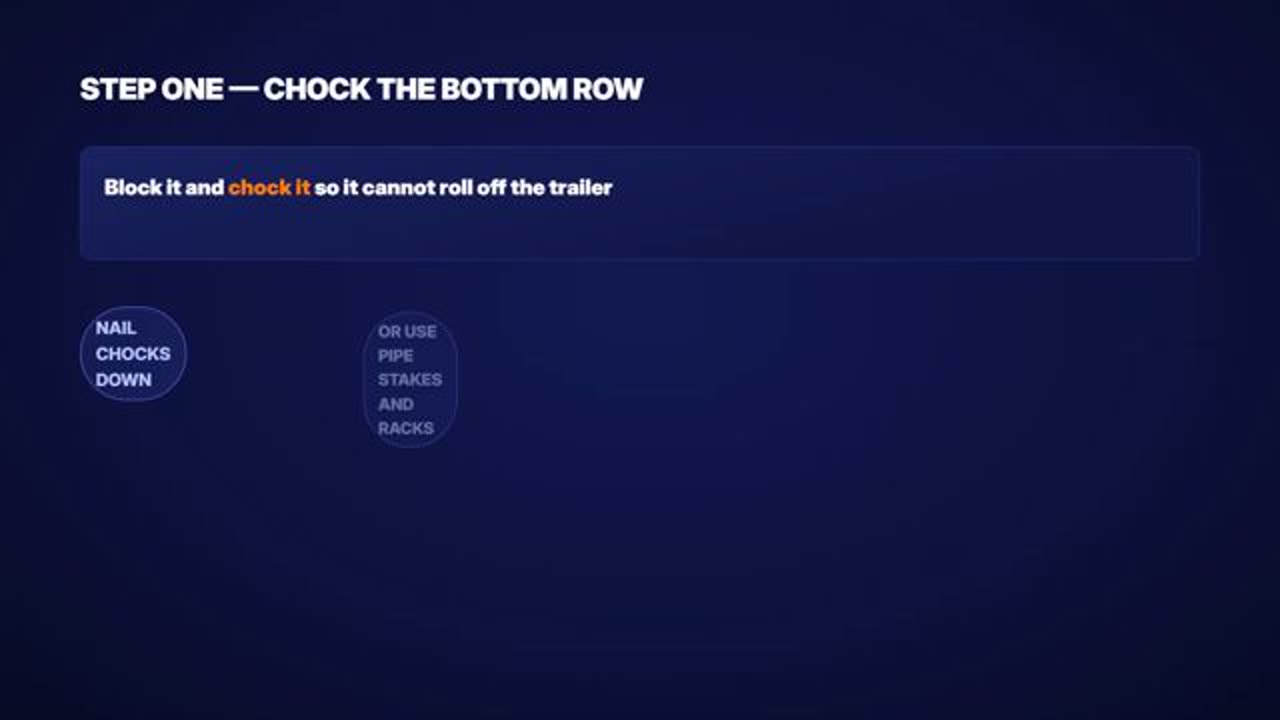
Block it and chock it so it cannot roll off the trailer. Nail your chocks down, or use pipe stakes and racks that are actually built to hold pipe — not scrap lumber you found in the yard.
Stack pattern matters
Only stack pipe in a stable nested pattern or a true pyramid — round locked into the row below it.
Bell and spigot concrete pipe gets its own rule — 393.124. That pipe has a wide end and a narrow end, and it can roll or telescope into itself if it isn't blocked and tied down exactly right. Know that section before you load it.
For tiedowns: go over the top, and add restraint against side movement too — over-the-top alone isn't enough. Hit your tiedown count for the length and weight, and every tiedown has to do its share within the fifty percent working load limit rule.
Between layers, use dunnage
Without it, pipe slides lengthwise and walks itself right out of your tiedowns.
Metal pipe has sharp cut ends and raw edges. Those edges will saw through a strap in a matter of miles. Use edge protection, and for metal pipe that usually means chain, not strap.
Load it even, side to side and front to back, and keep the center of gravity in mind — a lopsided pipe load can put you over on an axle even when the total weight is legal.
Your company standard: chock and block the roll. Stable nesting only — no loose stacking. Over-the-top restraint plus side restraint. Edge protection on every sharp end. And the correct tiedown count, every time.
FMCSA regulations this training supports
Assign it after a roadside inspection to coach the exact issue and document corrective training.
Sample quiz questions
3 of the 10 questions drivers answer after the video. Quizzes run in the driver's own language.
- There is no concern if total weight is legal
- A lopsided load can put you over on an axle even though total weight is legal
- It only matters for concrete pipe, not metal
- It's fine as long as tiedown count is correct
Show answer
A lopsided load can put you over on an axle even though total weight is legal
- Wrap it in a tarp
- Add reflective tape
- Weigh it on a scale
- Block and chock it so it cannot roll off the trailer
Show answer
Block and chock it so it cannot roll off the trailer
- Chocks nailed down, or pipe stakes and racks actually built to hold pipe
- Any scrap lumber found in the yard
- Bungee cords
- Rope alone with no blocking
Show answer
Chocks nailed down, or pipe stakes and racks actually built to hold pipe
How fleets use this training
Pick Pipe, Tube & Cylindrical Loads and send each driver a personal link by email, or copy the link and text it yourself.
Drivers watch on their phone and answer the quiz in their own language. No app, no login.
They sign on screen and get a certificate with your logo. Every completion is saved for DOT and insurance.
Train your drivers on Pipe, Tube & Cylindrical Loads
Included in the Full Library plan ($129.99/mo, unlimited drivers). Unlimited drivers, cancel anytime. Prefer to own it? Order it branded for $4.99, one time.
Frequently asked questions
How long is the Pipe, Tube & Cylindrical Loads training video?
About 3 min. Drivers watch it on their phone from a personal link, then take a 10-question quiz.
Is there a quiz and a completion certificate?
Yes. Every driver takes a 10-question quiz in their own language, signs on screen, and gets a completion certificate with your company name and logo. Records are saved for DOT audits and insurance.
Which FMCSA regulations does it cover?
It supports training for roadside violations including Paper rolls / concrete pipe (§393.122); Paper rolls / concrete pipe (§393.124).
Which languages is it available in?
Ready today in English. You can also order it branded in any other language for $2.99 per extra language.
How much does it cost?
Included in the Full Library plan ($129.99/mo, unlimited drivers). You can also order this video branded with your logo and company name in the voiceover for a one-time $4.99, yours to keep.