Cargo & Freight · Driver Training VideoChains, Binders & Working Load Limits
A chain with no readable tag has no known rating, and the total working load limit must reach half the cargo weight. Drivers learn tiedown counts by length, chain inspection, and why a cheater bar on a binder is dangerous.
 Branded with your logo & company name
What drivers learn
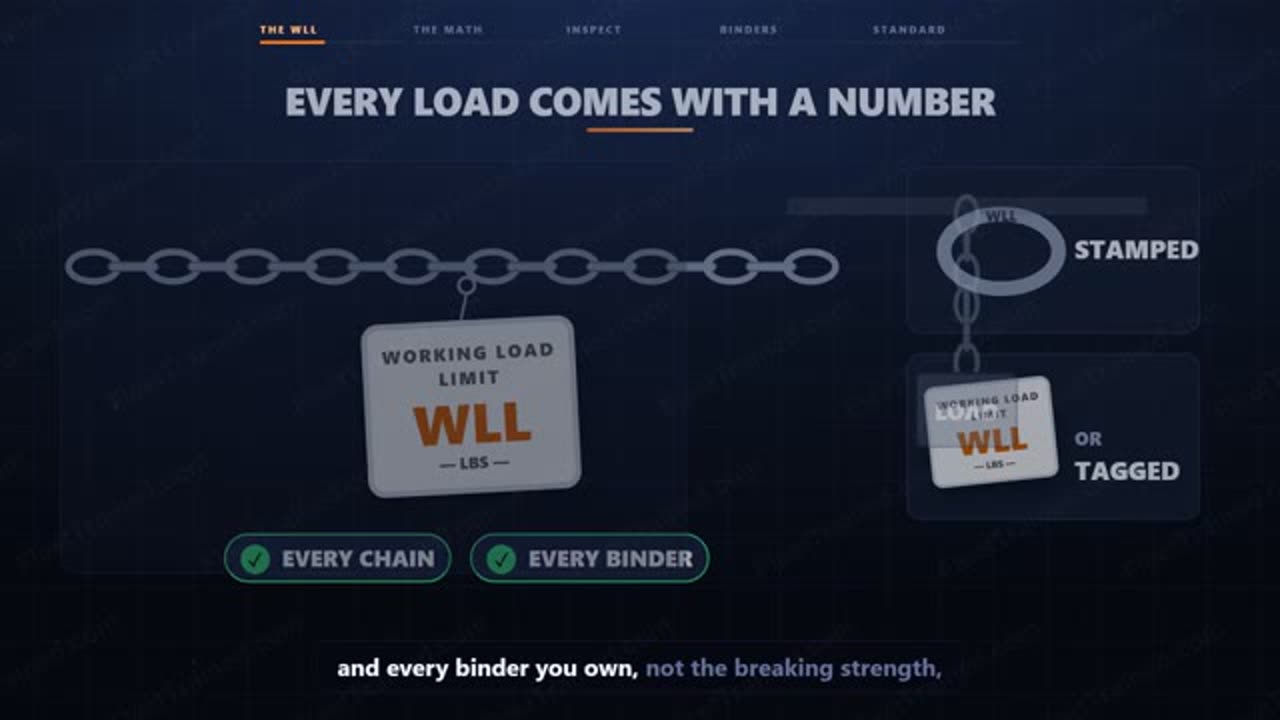
Every load you chain down comes with a number attached to it, whether you go looking for it or not. That number is the working load limit — the WLL — and it's stamped or tagged on every chain and every binder you own. Not the breaking strength.
Here's the rule that runs the whole job: the total working load limit of everything holding that cargo down has to add up to at least half the weight of the load. Not half of what you think it weighs — half of what it actually weighs, off the bill of lading.
Length sets your minimum count
Anything under ten feet needs at least two tiedowns. Past ten feet, add one more for every additional ten feet or fraction of it. That's a floor, not a target — awkward shapes, shifting cargo, or a rough route means more, never less.
Inspect the chain before it ever touches the load. Stretched links, cracked links, cuts, or any sign it's seen fire or heat damage — that chain is done, no exceptions. Damaged chain doesn't announce it's lost strength; it just fails when you need it most.
Binders get their own respect
Never slide a pipe or a cheater bar onto a binder handle for extra leverage — that overloads the binder past its rating and turns it into a spring-loaded hazard. When you release a lever or ratchet binder, stand clear of the swing path, not in line with the handle.
Your company standard: match every binder to the chain's rated capacity, protect the chain anywhere it crosses a sharp edge, and never load past the weakest link in the system — the chain, the binder, or the anchor point, whichever rates lowest.
Recheck your securement within the first fifty miles of every trip, then again every three hours or hundred fifty miles, or any time you change duty status. Chains loosen. Loads settle. That recheck catches it before the shoulder of the highway does.
FMCSA regulations this training supports
Assign it after a roadside inspection to coach the exact issue and document corrective training.
Sample quiz questions
3 of the 10 questions drivers answer after the video. Quizzes run in the driver's own language.
- Weight Load Limit — the maximum weight the truck can carry
- Working Load Limit — the rated safe holding capacity, not the breaking strength
- Working Load Limit — the load at which the chain will break
- Weight Limit Line — a marking used only on binders
Show answer
Working Load Limit — the rated safe holding capacity, not the breaking strength
- Assume it matches your other chains and use it
- Estimate the rating based on link thickness
- Use it only for lighter loads
- Don't use it — if you don't know the number, that chain doesn't go on the load
Show answer
Don't use it — if you don't know the number, that chain doesn't go on the load
- At least equal to the load weight
- At least twice the load weight
- At least half the load's actual weight, from the bill of lading
- At least half of what you visually estimate the load weighs
Show answer
At least half the load's actual weight, from the bill of lading
How fleets use this training
Pick Chains, Binders & Working Load Limits and send each driver a personal link by email, or copy the link and text it yourself.
Drivers watch on their phone and answer the quiz in their own language. No app, no login.
They sign on screen and get a certificate with your logo. Every completion is saved for DOT and insurance.
Train your drivers on Chains, Binders & Working Load Limits
Included in the Full Library plan ($129.99/mo, unlimited drivers). Unlimited drivers, cancel anytime. Prefer to own it? Order it branded for $4.99, one time.
Frequently asked questions
How long is the Chains, Binders & Working Load Limits training video?
About 3 min. Drivers watch it on their phone from a personal link, then take a 10-question quiz.
Is there a quiz and a completion certificate?
Yes. Every driver takes a 10-question quiz in their own language, signs on screen, and gets a completion certificate with your company name and logo. Records are saved for DOT audits and insurance.
Which FMCSA regulations does it cover?
It supports training for roadside violations including Securement WLL & tiedowns (§393.100); Securement WLL & tiedowns (§393.101); Securement WLL & tiedowns (§393.102); Securement WLL & tiedowns (§393.103).
Which languages is it available in?
Ready today in English. You can also order it branded in any other language for $2.99 per extra language.
How much does it cost?
Included in the Full Library plan ($129.99/mo, unlimited drivers). You can also order this video branded with your logo and company name in the voiceover for a one-time $4.99, yours to keep.