Cargo & Freight · Driver Training VideoCargo & Dunnage Securement at the Dock
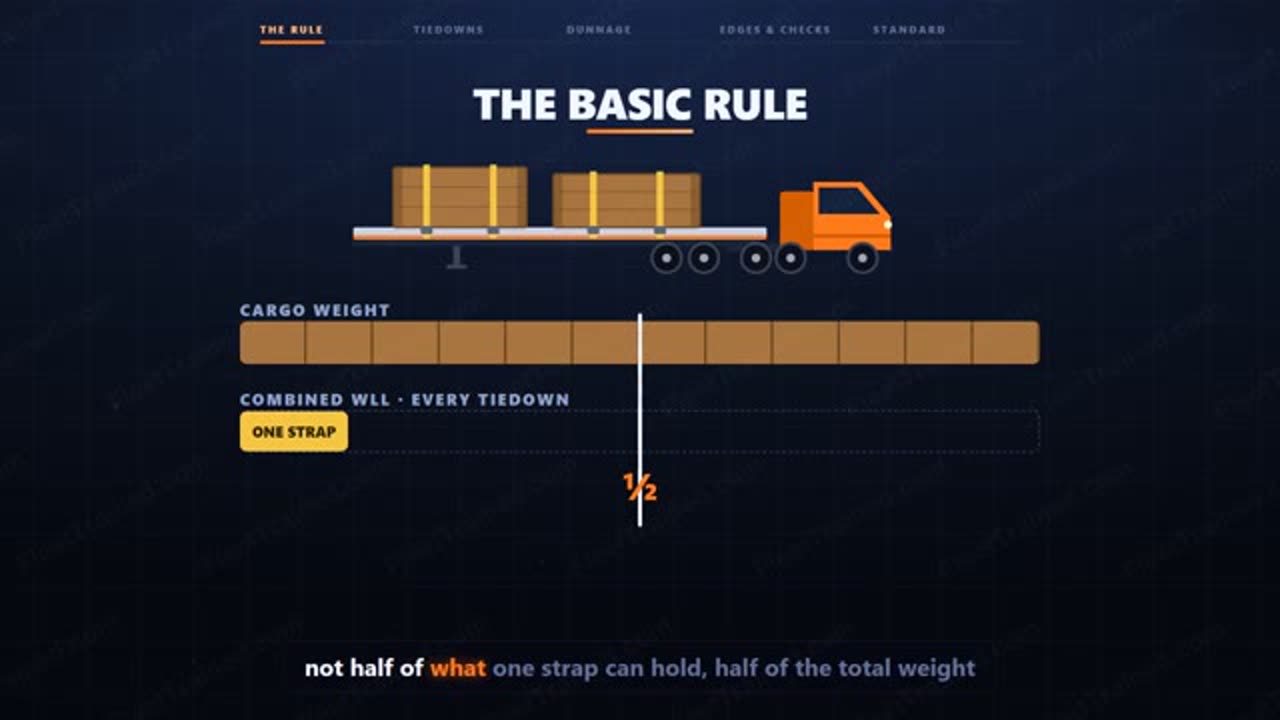
The combined working load limit of all tiedowns must equal at least half the cargo weight, not half of one strap. Drivers learn tiedown counts by length and weight, blocking and bracing, and edge protection.
 Branded with your logo & company name
What drivers learn
Start with the basic rule: the combined working load limit of everything holding a load down has to equal at least half the weight of that cargo. Not half of what one strap can hold — half of the total weight, added up across every tiedown you're using.
The number of tiedowns is tied to size, not judgment. An article five feet or shorter that weighs 1,100 pounds or less needs one tiedown, minimum. Anything heavier than that, or anything longer than five feet, needs at least two.
Dunnage does a job a strap can't do. Blocking and bracing — the wood, airbags, or void-fillers packed between and around a load — stop it from shifting sideways or walking forward under braking, before a single tiedown even gets tightened.
Edge protection matters as much as the count. Any tiedown running over a sharp corner or an edge that can saw through webbing needs a corner protector or edge guard. A strap that gets cut at highway speed isn't a paperwork problem — it's debris in a live lane.
This isn't a one-time check at the dock. Inspect the load again within the first fifty miles of any trip — things settle and shift right after loading, more than at any other point.
Your company standard: verify the tiedown count and total working load limit against the load's actual weight before you leave the dock — read it off the placard or the bill of lading, not from memory.
None of this is about slowing down the dock. It's about a load that's still exactly where you strapped it when you get where you're going.
FMCSA regulations this training supports
Assign it after a roadside inspection to coach the exact issue and document corrective training.
Sample quiz questions
3 of the 10 questions drivers answer after the video. Quizzes run in the driver's own language.
- Each individual strap's WLL must equal half the cargo weight by itself.
- The combined working load limit of all tiedowns must equal at least half the total cargo weight.
- The combined WLL must equal the full cargo weight.
- Only the strap closest to the cab needs to meet a WLL requirement.
Show answer
The combined working load limit of all tiedowns must equal at least half the total cargo weight.
- One tiedown, minimum.
- No tiedown is required for loads under 1,000 pounds.
- Two tiedowns, minimum.
- Three tiedowns, minimum.
Show answer
One tiedown, minimum.
- One, since it's under 10 feet.
- Three, since it's over a ton.
- Two, since it's heavier than 1,100 pounds and longer than 5 feet.
- Four, to be safe.
Show answer
Two, since it's heavier than 1,100 pounds and longer than 5 feet.
How fleets use this training
Pick Cargo & Dunnage Securement at the Dock and send each driver a personal link by email, or copy the link and text it yourself.
Drivers watch on their phone and answer the quiz in their own language. No app, no login.
They sign on screen and get a certificate with your logo. Every completion is saved for DOT and insurance.
Train your drivers on Cargo & Dunnage Securement at the Dock
Included in the Full Library plan ($129.99/mo, unlimited drivers). Unlimited drivers, cancel anytime. Prefer to own it? Order it branded for $4.99, one time.
Frequently asked questions
How long is the Cargo & Dunnage Securement at the Dock training video?
About 3 min. Drivers watch it on their phone from a personal link, then take a 10-question quiz.
Is there a quiz and a completion certificate?
Yes. Every driver takes a 10-question quiz in their own language, signs on screen, and gets a completion certificate with your company name and logo. Records are saved for DOT audits and insurance.
Which FMCSA regulations does it cover?
It supports training for roadside violations including Load not secured (§392.9); Commodity-specific securement (§393.126); Commodity-specific securement (§393.127); Commodity-specific securement (§393.129).
Which languages is it available in?
Ready today in English. You can also order it branded in any other language for $2.99 per extra language.
How much does it cost?
Included in the Full Library plan ($129.99/mo, unlimited drivers). You can also order this video branded with your logo and company name in the voiceover for a one-time $4.99, yours to keep.