Insurance & Liability · Driver Training VideoWhat (Not) to Say After a Crash
What a driver says in the first ninety seconds after a crash can follow them for years in court and claim files. Drivers learn why "I'm sorry" reads as an admission and to stick to facts with police.
 Branded with your logo & company name
What drivers learn
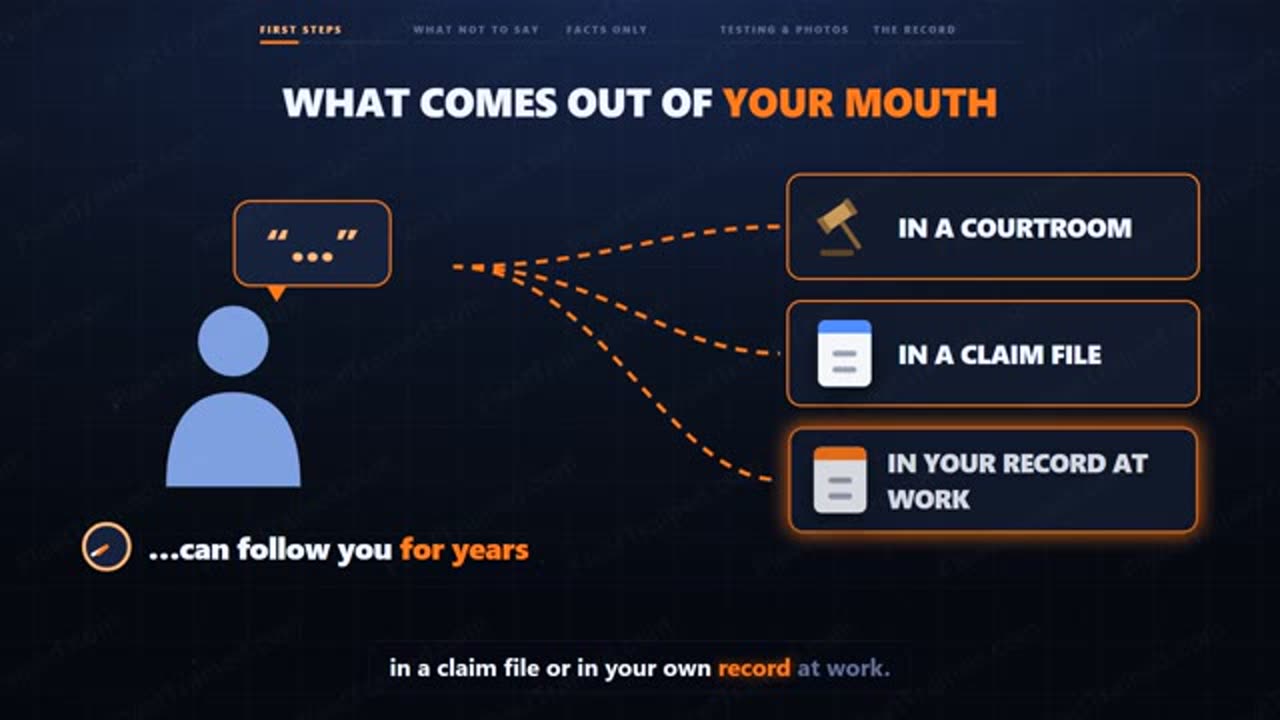
The first ninety seconds after a collision decide a lot. Not the crash itself — the aftermath. What comes out of your mouth in that window can follow you for years, in a courtroom, in a claim file, or in your own record at work.
Start with the basics
Stop. Protect the scene — triangles out, hazards on. Check for injuries and call 911 if it hasn't already been done. Then call your dispatch or safety department right after.
Here's the part that trips drivers up: never say "I'm sorry" at the scene, even out of instinct. It sounds like an apology for being at fault, and it gets written into police reports and insurance files as exactly that — an admission. You can be human without admitting fault.
Stick to facts with law enforcement: your name, your license, your carrier's information, and what you observed. Cooperating with police and exchanging the required information is mandatory.
Your company standard: every driver involved in an accident cooperates fully with the investigation — but that investigation happens with your safety department, not with opinions traded at the scene.
One more thing: if the crash meets the federal definition of an accident, it goes into the company's accident register, kept for three years, with the same facts you gave at the scene.
Sample quiz questions
3 of the 10 questions drivers answer after the video. Quizzes run in the driver's own language.
- Call dispatch, then stop and check for injuries
- Stop, protect the scene with triangles/hazards, check for injuries, and call 911 if not already done
- Take photos of damage, then move the vehicle out of traffic
- Exchange insurance information first, then check for injuries
Show answer
Stop, protect the scene with triangles/hazards, check for injuries, and call 911 if not already done
- It's considered unprofessional company conduct
- It can slow down the police report process
- It can be written into reports and insurance files as an admission of fault
- Dispatch requires a different phrase instead
Show answer
It can be written into reports and insurance files as an admission of fault
- Your dispatch or safety department
- The other driver's employer
- A personal injury attorney
- The DOT regional office
Show answer
Your dispatch or safety department
How fleets use this training
Pick What (Not) to Say After a Crash and send each driver a personal link by email, or copy the link and text it yourself.
Drivers watch on their phone and answer the quiz in their own language. No app, no login.
They sign on screen and get a certificate with your logo. Every completion is saved for DOT and insurance.
Train your drivers on What (Not) to Say After a Crash
Included in the Full Library plan ($129.99/mo, unlimited drivers). Unlimited drivers, cancel anytime. Prefer to own it? Order it branded for $4.99, one time.
Frequently asked questions
How long is the What (Not) to Say After a Crash training video?
About 3 min. Drivers watch it on their phone from a personal link, then take a 10-question quiz.
Is there a quiz and a completion certificate?
Yes. Every driver takes a 10-question quiz in their own language, signs on screen, and gets a completion certificate with your company name and logo. Records are saved for DOT audits and insurance.
Which languages is it available in?
Ready today in English. You can also order it branded in any other language for $2.99 per extra language.
How much does it cost?
Included in the Full Library plan ($129.99/mo, unlimited drivers). You can also order this video branded with your logo and company name in the voiceover for a one-time $4.99, yours to keep.