Defensive Driving · Driver Training VideoRural Roads & Animal Strikes
More than half of fatal truck crashes happen in rural areas, and swerving for a deer can put the truck in the ditch or on its side. Drivers learn to brake straight, hold the wheel when a tire drops off, and fit speed to headlight range.
 Branded with your logo & company name
What drivers learn
More than half of fatal truck crashes do not happen in city traffic. They happen out here, in rural areas, often on two lane roads with no shoulder, no lighting, and nobody around. Empty does not mean safe.
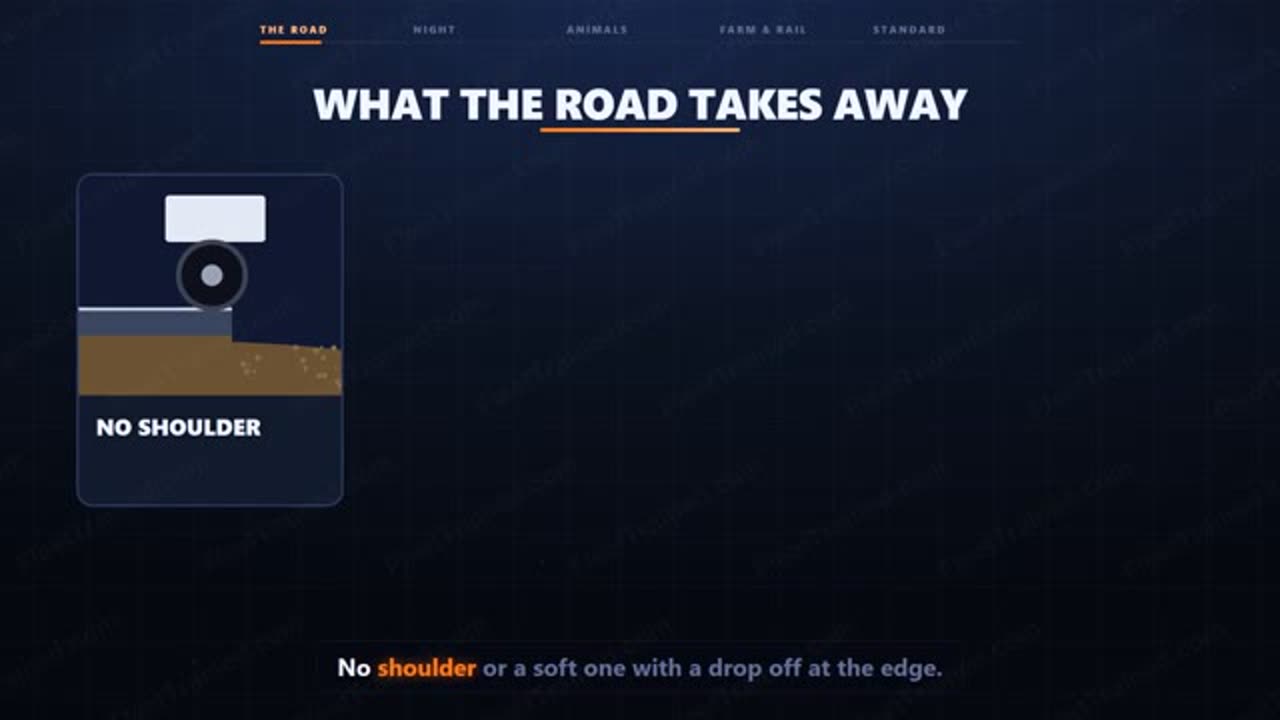
Start with what the road takes away. No shoulder, or a soft one with a drop off at the edge. Gravel that moves under a loaded trailer. Blind crests, and unmarked intersections where the cross traffic never had a stop sign. If a tire drops off the pavement, do not jerk it back.
At night your real limit is your headlights. On low beams you see about two hundred fifty feet. A loaded rig at highway speed needs more room than that to stop. Your speed has to fit the light you have, not the number on the sign. High beams when nothing is oncoming.
Now the animals
Deer move at dawn and dusk, and the worst months are October through December, when they are running. Scan the ditch line and the tree edge, not just the pavement. Look for eye shine. And if you see one deer, there are more behind it.
Here is the part drivers get wrong. Do not swerve for an animal. Coming out of your lane at highway speed puts you into oncoming traffic, into the ditch, or on your side, and now the crash is yours. Brake hard and straight, both hands on the wheel, and let the truck take the hit.
If you do hit one, get off the road if you can, hazards on, and stay in the cab. A wounded animal is dangerous. Call it in to dispatch and law enforcement. Then look the truck over.
Big animals change the math
Moose, elk, and open range cattle stand high enough that the body can come over the hood and into the glass. In open range country, many states put the cost of hitting livestock on the driver, not the rancher.
Then there is farm equipment
A tractor or a combine may be doing fifteen miles an hour, and it may be wider than the lane. The orange triangle means the machine is built to run twenty five or less. At highway speed you close on it at about sixty feet every second.
Sample quiz questions
3 of the 10 questions drivers answer after the video. Quizzes run in the driver's own language.
- In heavy city traffic
- In rural areas, often on two-lane roads
- In construction zones
- In parking lots and yards
Show answer
In rural areas, often on two-lane roads
- Jerk the wheel back onto the pavement immediately
- Accelerate to pull the trailer back up
- Hold it straight, ease off the throttle, brake gently, and come back on once slowed
- Brake hard and turn sharply toward the center line
Show answer
Hold it straight, ease off the throttle, brake gently, and come back on once slowed
- 100 feet
- 250 feet
- 500 feet
- 1,000 feet
Show answer
250 feet
How fleets use this training
Pick Rural Roads & Animal Strikes and send each driver a personal link by email, or copy the link and text it yourself.
Drivers watch on their phone and answer the quiz in their own language. No app, no login.
They sign on screen and get a certificate with your logo. Every completion is saved for DOT and insurance.
Train your drivers on Rural Roads & Animal Strikes
Included in the Full Library plan ($129.99/mo, unlimited drivers). Unlimited drivers, cancel anytime. Prefer to own it? Order it branded for $4.99, one time.
Frequently asked questions
How long is the Rural Roads & Animal Strikes training video?
About 4 min. Drivers watch it on their phone from a personal link, then take a 10-question quiz.
Is there a quiz and a completion certificate?
Yes. Every driver takes a 10-question quiz in their own language, signs on screen, and gets a completion certificate with your company name and logo. Records are saved for DOT audits and insurance.
Which languages is it available in?
Ready today in English. You can also order it branded in any other language for $2.99 per extra language.
How much does it cost?
Included in the Full Library plan ($129.99/mo, unlimited drivers). You can also order this video branded with your logo and company name in the voiceover for a one-time $4.99, yours to keep.