Fuel, Cost & Efficiency · Driver Training VideoFuel Economy Driving Techniques
Every mile per hour shaved off cruise speed above 60 saves roughly a tenth of a mile per gallon, and an overnight idle burns close to a gallon an hour. Drivers learn speed, braking, shifting, and tire pressure habits that add miles per gallon.
 Branded with your logo & company name
What drivers learn
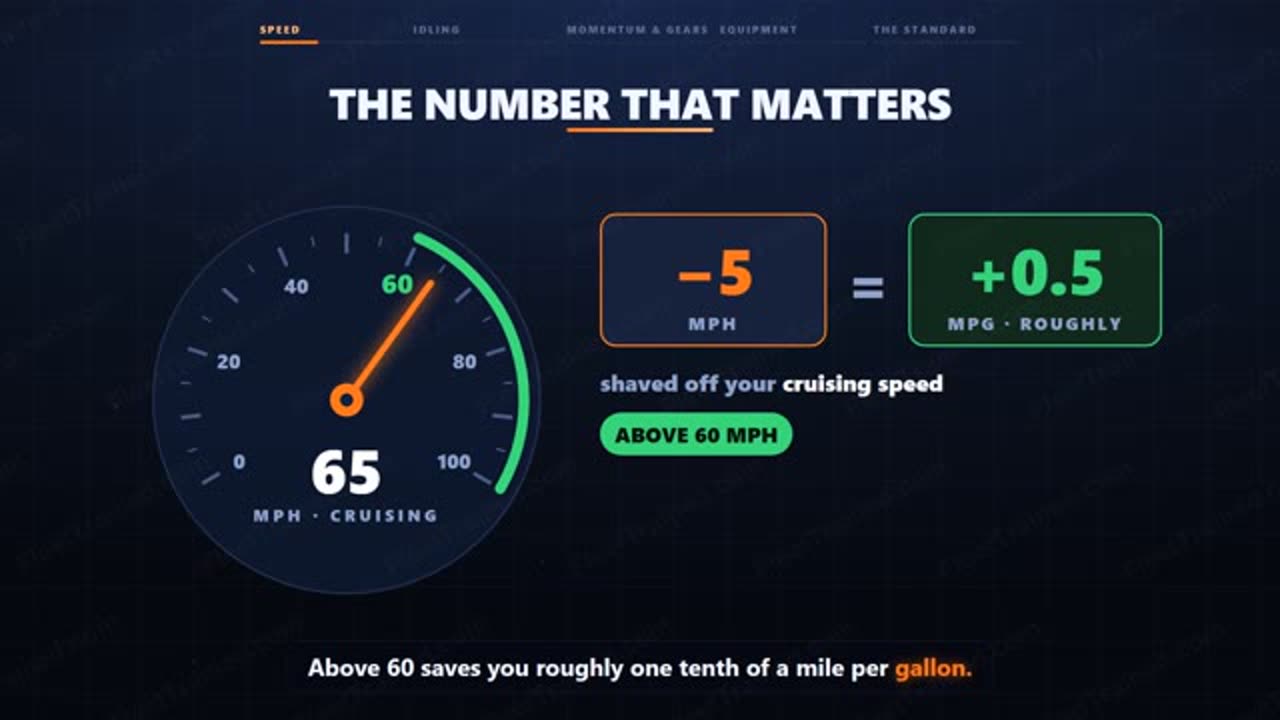
Here's the number that matters: every one mile-per-hour you shave off your cruising speed above 60 saves you roughly one tenth of a mile per gallon. That's not a rounding error. Run 65 instead of 70 all day and you can add half a mile per gallon or more to your average.
Idling is the next big one. A sleeper cab idling overnight burns close to a gallon of fuel an hour for zero miles. Ten hours of idling is ten gallons gone before the truck ever moves.
Momentum is free fuel
Every hard brake throws away speed you paid diesel to build. Look far enough down the road to see the slowdown coming — a light, a hill, traffic — and ease off the pedal early instead of coasting up fast and stabbing the brakes.
Progressive shifting matters too
Short-shifting at lower RPM keeps the engine out of its thirstiest range. Let cruise control and the engine brake do the work on rolling terrain instead of chasing the accelerator up every hill and coasting down the other side.
Tire pressure is a five-minute check with a real payoff. Underinflated tires increase rolling resistance, and running every tire ten PSI low can cost you about one percent in fuel economy. Check them cold, check them often, and report anything that looks off before you roll.
Aerodynamics count more than people think. Gaps between the tractor and trailer, a raised fifth wheel, missing fairings — all of it adds drag at highway speed. Keep the equipment closed up the way it was built to run, and report any missing panels.
Your company standard: run the posted speed or five under on undivided highways, keep idling to genuine need only, use progressive shifting and cruise control on the interstate, check tire pressure at every pre-trip, and report any aerodynamic equipment that's damaged or missing.
The trucks that get the best numbers aren't driven by the most cautious drivers. They're driven by the ones who look furthest ahead and touch the brake pedal the least. That habit costs you nothing and pays you back every single mile.
Sample quiz questions
3 of the 10 questions drivers answer after the video. Quizzes run in the driver's own language.
- About one full mile per gallon
- About one percent of total fuel cost
- About one tenth of a mile per gallon
- About half a mile per gallon
Show answer
About one tenth of a mile per gallon
- Shifting into the highest gear as fast as possible
- Short-shifting at lower RPM to keep the engine out of its thirstiest range
- Staying in one gear for the entire trip
- Shifting only when the engine redlines
Show answer
Short-shifting at lower RPM to keep the engine out of its thirstiest range
- A gallon every ten hours
- Half a gallon an hour
- Two gallons an hour
- Close to a gallon an hour
Show answer
Close to a gallon an hour
How fleets use this training
Pick Fuel Economy Driving Techniques and send each driver a personal link by email, or copy the link and text it yourself.
Drivers watch on their phone and answer the quiz in their own language. No app, no login.
They sign on screen and get a certificate with your logo. Every completion is saved for DOT and insurance.
Train your drivers on Fuel Economy Driving Techniques
Included in the Full Library plan ($129.99/mo, unlimited drivers). Unlimited drivers, cancel anytime. Prefer to own it? Order it branded for $4.99, one time.
Frequently asked questions
How long is the Fuel Economy Driving Techniques training video?
About 3 min. Drivers watch it on their phone from a personal link, then take a 10-question quiz.
Is there a quiz and a completion certificate?
Yes. Every driver takes a 10-question quiz in their own language, signs on screen, and gets a completion certificate with your company name and logo. Records are saved for DOT audits and insurance.
Which languages is it available in?
Ready today in English. You can also order it branded in any other language for $2.99 per extra language.
How much does it cost?
Included in the Full Library plan ($129.99/mo, unlimited drivers). You can also order this video branded with your logo and company name in the voiceover for a one-time $4.99, yours to keep.