Weather & Seasonal · Driver Training VideoBlack Ice — Deep Dive
Black ice is thin, clear, and invisible until a truck is already on it, and stopping distance can double or triple. Drivers learn where it forms, how to slow before it, and why a jake brake on glare ice can lock the drive wheels.
 Branded with your logo & company name
What drivers learn
Start with why it forms
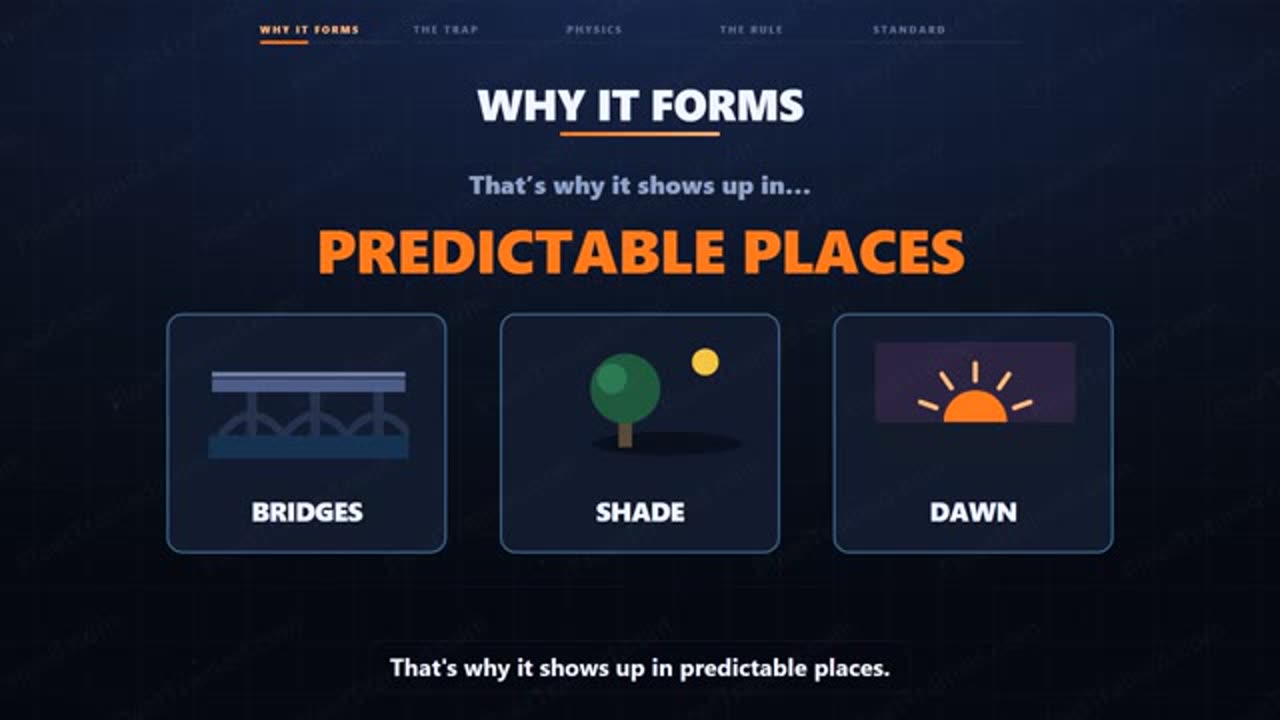
Black ice needs two things: moisture, and a surface that drops below freezing faster than the air around it. That's why it shows up in predictable places. Bridges and overpasses freeze first — no ground underneath to hold heat, so both sides of the deck lose warmth at once.
Here's the trap
Black ice is thin, clear, and takes on the color of the road underneath it. You will not see it coming. You'll feel it instead — a sudden looseness in the steering, a trailer that starts to drift, a truck ahead of you that's suddenly sideways for no reason.
Now the physics
On dry pavement, a loaded rig might need five to six hundred feet to stop from highway speed. On ice, that distance can double, triple, or more, and a steering move that would correct a skid on dry pavement can throw a truck sideways on ice. There is no fast way out of a skid.
So the rule is simple: if you suspect ice, you slow down before you're on it, not after. Cover the brake — don't stand on it.
Your company standard: treat every bridge, every overpass, and every shaded curve as a possible ice patch from fall through spring, whether the thermometer reads freezing or not. Back off the truck ahead before the curve, not inside it.
Sample quiz questions
3 of the 10 questions drivers answer after the video. Quizzes run in the driver's own language.
- Cold wind and dry pavement
- Heavy traffic and low humidity
- Moisture and a surface cooling faster than the surrounding air
- Rain and high traffic speed
Show answer
Moisture and a surface cooling faster than the surrounding air
- They have no ground underneath to hold heat, so both sides of the deck lose warmth at once
- They are always shaded by trees
- They get more direct wind exposure
- They are treated with less road salt
Show answer
They have no ground underneath to hold heat, so both sides of the deck lose warmth at once
- Midday when traffic is heaviest
- Late afternoon before sunset
- Right after a snowstorm
- Dawn, after a clear night let heat radiate off the pavement
Show answer
Dawn, after a clear night let heat radiate off the pavement
How fleets use this training
Pick Black Ice — Deep Dive and send each driver a personal link by email, or copy the link and text it yourself.
Drivers watch on their phone and answer the quiz in their own language. No app, no login.
They sign on screen and get a certificate with your logo. Every completion is saved for DOT and insurance.
Train your drivers on Black Ice — Deep Dive
Included in the Full Library plan ($129.99/mo, unlimited drivers). Unlimited drivers, cancel anytime. Prefer to own it? Order it branded for $4.99, one time.
Frequently asked questions
How long is the Black Ice — Deep Dive training video?
About 3 min. Drivers watch it on their phone from a personal link, then take a 10-question quiz.
Is there a quiz and a completion certificate?
Yes. Every driver takes a 10-question quiz in their own language, signs on screen, and gets a completion certificate with your company name and logo. Records are saved for DOT audits and insurance.
Which languages is it available in?
Ready today in English. You can also order it branded in any other language for $2.99 per extra language.
How much does it cost?
Included in the Full Library plan ($129.99/mo, unlimited drivers). You can also order this video branded with your logo and company name in the voiceover for a one-time $4.99, yours to keep.